
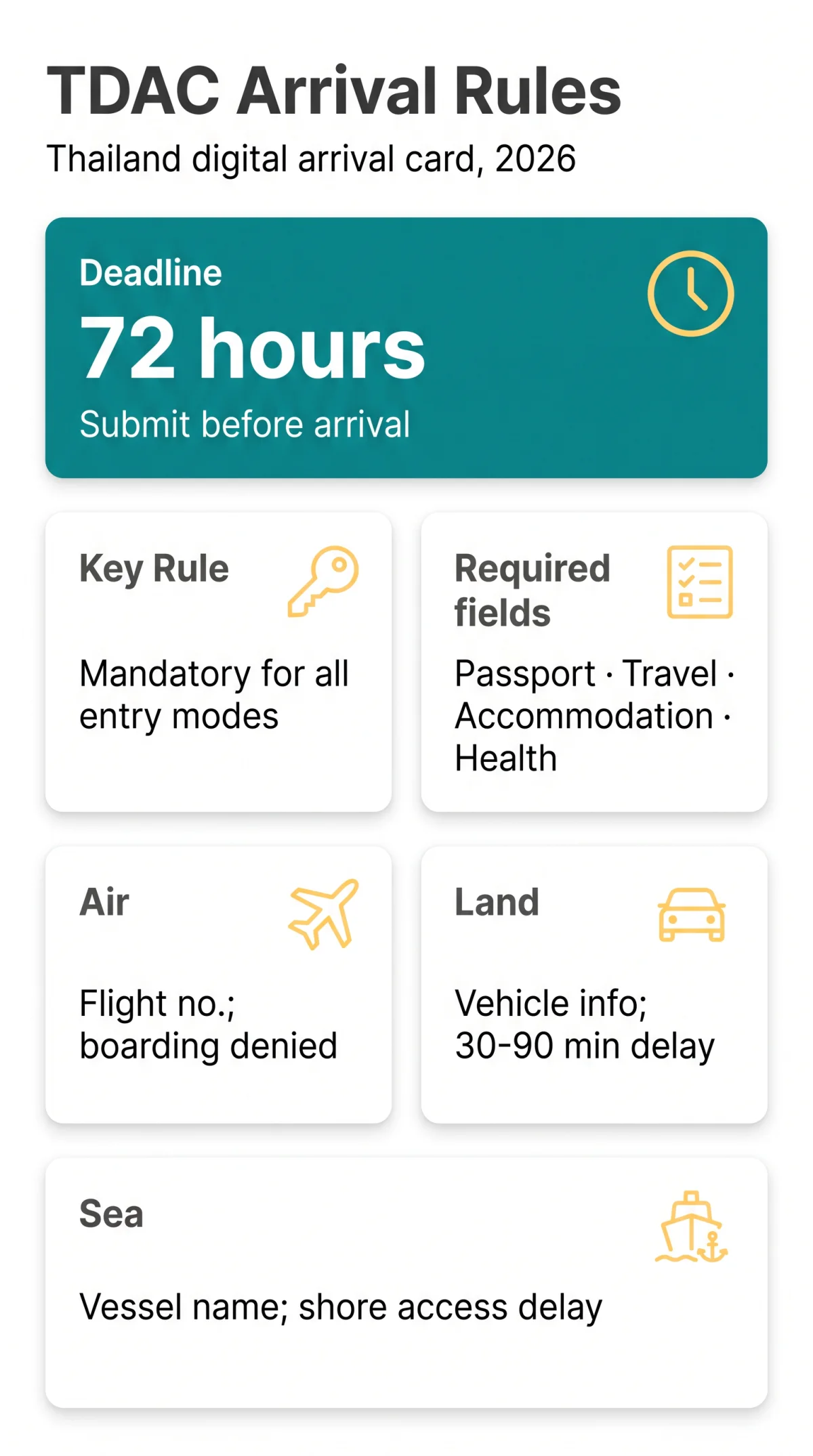
Thailand’s TDAC is mandatory for all entry modes and must be submitted online within 72 hours before arrival. This guide breaks down field-level differences in the TDAC form for air, land, and sea entry, then contrasts them with Singapore’s SGAC, Malaysia’s MDAC, Cambodia’s e-Arrival, and Vietnam’s paid e-Visa. Last reviewed: 2026.
While Singapore, Malaysia, and Cambodia offer similar free digital arrival cards with a three-day submission window, Vietnam requires a paid e-visa. Understanding the specific field changes for aviation, ground, and sea port entry will ensure you avoid airline boarding denials or delays at ground checkpoints.
What Is the Thailand Digital Arrival Card (TDAC)?
TDAC is a free, mandatory digital replacement for the paper TM6 card, due 72 hours before arrival.
The Thailand Digital Arrival Card (TDAC) is a mandatory immigration requirement for all non-Thai nationals, replacing the paper TM6 card from May 2025. The system generates a PDF confirmation with a QR code and allows group submissions for up to 10 travellers. Required fields include:
- Passport information (MRZ upload available)
- Personal information
- Travel information
- Accommodation information in Thailand
- Health declaration information
For offline assistance, the Royal Thai Consulate-General, HK is located at 8/F, Fairmont House, 8 Cotton Tree Drive, Central, Hong Kong (Open Mon-Fri, 9:00 am – 5:00 pm, Tel: +852 2521 6481 – 5).
Air vs Land vs Sea – How the TDAC Process Actually Differs
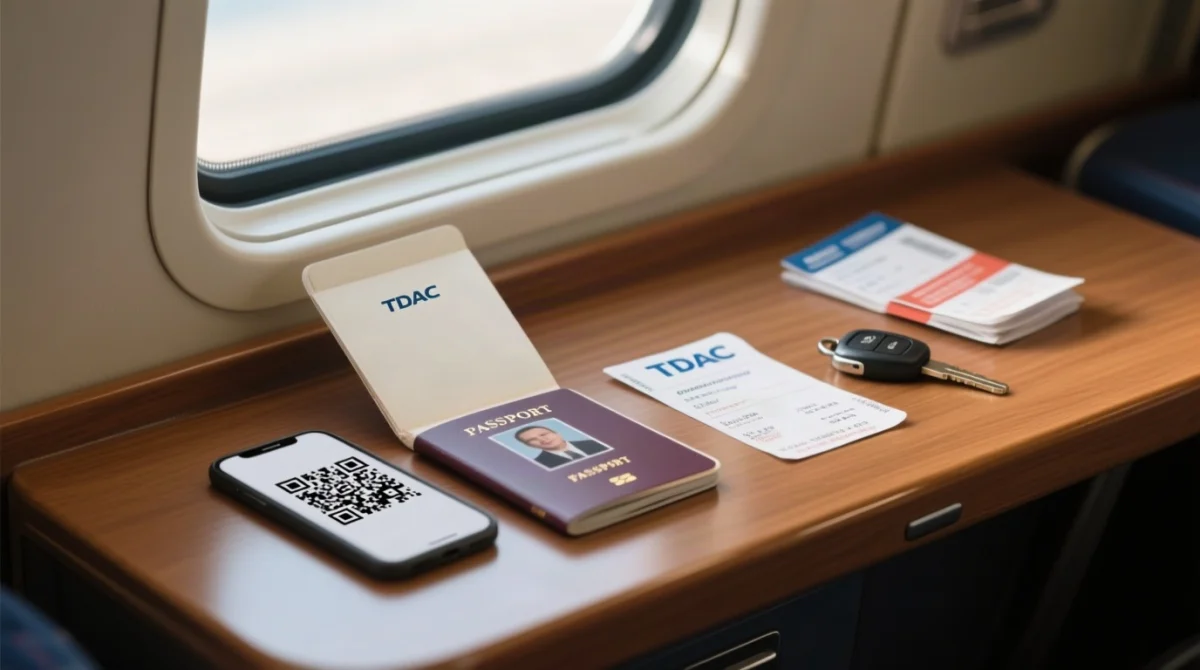
The Thailand Digital Arrival Card (TDAC) is required for all three entry modes, but airlines may deny boarding without it while land crossings allow on-site help-point completion. Selecting ‘Air’ in the TDAC portal reveals flight number and departure airport fields; ‘Land’ requires a border checkpoint code and bus/van plate number; ‘Sea’ captures vessel name and arrival pier. Airlines verify the QR code at check-in, while land crossings allow on-site kiosk completion.
| Entry Mode | Required Fields | Consequence of no TDAC |
|---|---|---|
| Air | Flight number, departure airport | Airline boarding denial |
| Land | Vehicle registration, walk-in status | Border-side manual delay |
| Sea | Vessel name, embarkation port | Shore access delay |
Arriving by Air – Flight Details, E-Gates, and Airline Pre-Checks
The Thailand Digital Arrival Card (TDAC) for air requires flight numbers and departure airports. Airlines verify the QR code; e-gates ensure 5-15 minute processing.
Land Border Crossings – Buses, Cars, and Walking Across
The Thailand Digital Arrival Card (TDAC) requires vehicle registration or walk-in status. Kiosks at major crossings like Aranyaprathet, Sadao, Mukdahan, Mae Sai, and Nong Khai handle manual processing in 15-30 minutes for overland entry.
Arriving by Sea – Cruise Ships, Ferries, and Yachts
The Thailand Digital Arrival Card (TDAC) for sea requires vessel name and port. Group submission (max 10 pax) is available only for cruises; ferry passengers (e.g., Langkawi-Satun route) must each hold a separate TDAC confirmation.
TDAC vs Singapore’s SG Arrival Card
Singapore’s SG Arrival Card is free with a 3-day submission window like the Thailand Digital Arrival Card (TDAC), but applies only to specific nationalities – not all foreign arrivals.
| Feature | Thailand (TDAC) | Singapore (SGAC) |
|---|---|---|
| Cost | Free (0 THB) | Free |
| Submission Window | Up to 3 days | Up to 3 days |
TDAC vs Malaysia’s MDAC (Malaysia Digital Arrival Card)
Malaysia’s MDAC shares the Thailand Digital Arrival Card (TDAC) free cost and 3-day window but is a separate obligation; land-crossing travellers between both countries must submit both.
Backpackers crossing the Sadao (Songkhla) or Padang Besar checkpoints must submit both Malaysia’s MDAC (via MyEG) and Thailand’s TDAC separately. No data is shared between the two systems – a land-specific TDAC field requires the border checkpoint code.
| Feature | Thailand (TDAC) | Malaysia (MDAC) |
|---|---|---|
| Cost | Free (0 THB) | Free |
| Submission Window | Up to 3 days | Up to 3 days |
TDAC vs Cambodia’s e-Arrival Card and Vietnam’s e-Visa
Cambodia’s e-Arrival Card is free like the Thailand Digital Arrival Card (TDAC), but Vietnam charges roughly $25 USD for an e-visa – a different legal category entirely.
Quick Comparison Table – All Five Digital Arrival Systems
Thailand, Singapore, Malaysia, and Cambodia all offer free digital arrival cards; Vietnam is the outlier with a paid e-visa system. Ensure you complete the Thailand Digital Arrival Card (TDAC) and other required forms before reaching the border.
| Country | System | Cost | Submission Window |
|---|---|---|---|
| Thailand | TDAC | Free (0 THB) | Up to 3 days |
| Singapore | SG Arrival Card | Free | Up to 3 days |
| Malaysia | MDAC | Free | Up to 3 days |
| Cambodia | e-Arrival Card | Free | Up to 3 days |
| Vietnam | e-Visa | ~$25 USD | N/A |
What Happens If You Don’t Submit? Consequences by Mode of Entry
For air arrivals, airlines deny boarding. For land crossings, expect 30-90 minute delays. Failing to submit the Thailand Digital Arrival Card (TDAC) dictates different consequences depending on your route.
- London Flight (Air): British tourists on a London flight to Bangkok will have their TDAC QR code scanned at the boarding gate. Without it, airlines deny boarding outright.
- KL Bus (Land): No QR code at Sadao or Aranyaprathet? Plan for 30-90 min manual form completion at help-point kiosks – versus 5-15 min with a pre-filled TDAC.
- Langkawi Ferry (Sea): Passengers arriving by sea without a pre-filled Thailand Digital Arrival Card (TDAC) face shore access delays while completing individual declarations.
Practical Tips for Multi-Country Trips Across Southeast Asia
Backpackers crossing Malaysia, Thailand, Cambodia, and Vietnam need four separate digital forms – prepare accommodation addresses in advance for each border. The Thailand Digital Arrival Card (TDAC) is just one part of the regional requirements.
Prepare Accommodation Details
The TDAC strictly requires a confirmed hotel address in English, just like Malaysia’s MDAC and Cambodia’s e-Arrival Card.
Save Offline QR Codes
Take screenshots of your free (0 THB) TDAC confirmation to bypass roaming data issues at remote checkpoints.
Verify Regional Requirements
Ensure your passport meets validity rules for all planned border crossings across Southeast Asia.
Frequently Asked Questions (FAQ)
Do children need their own Thailand Digital Arrival Card (TDAC)?
Yes, the Thailand Digital Arrival Card (TDAC) is mandatory for all non-Thai nationals, including children. However, families travelling together do not need to submit entirely separate applications one by one. The system allows for a group submission of up to 10 travellers, making it easier for parents.
Is the TDAC the same as a Thai visa?
No, the Thailand Digital Arrival Card (TDAC) is not a visa. It is simply a digital arrival and health declaration form that replaced the traditional paper TM6 card. Depending on your nationality and the length of your stay in 2026, you may still need to secure a separate visa.
Are there paper card fallbacks at land border checkpoints?
Yes, there are fallback options available. While the digital form replaced the paper TM6 card in May 2025, some land border checkpoints and sea port entry locations maintain a physical paper arrival card system as a fallback. Major land crossings also feature help-point kiosks for on-site completion.
Do transit or transfer passengers need a TDAC?
Transit and transfer passengers are exempt from submitting a Thailand Digital Arrival Card (TDAC) provided they remain entirely within the sterile transit zone of the airport without clearing immigration. If your itinerary requires you to clear immigration, you must complete the TDAC process prior to your arrival.
When will the THIM Mobile App launch?
The THIM Mobile App is scheduled to launch in August 2026. This application will serve as an optional complementary channel for travellers. The app does not replace the requirement for the Thailand Digital Arrival Card (TDAC) itself.
Can I edit my TDAC after generating the QR code?
TDAC guidelines do not specify an edit option after QR generation. Travellers must ensure all required data, including passport details, travel history, and accommodation information, is entirely accurate before submitting the Thailand Digital Arrival Card (TDAC) within the 72-hour window.
Does the TDAC guarantee entry into Thailand?
No. The TDAC is a declaration, not a visa – immigration officers retain final discretion at any air, land, or sea port.
What is the exact portal URL for the TDAC?
The designated external government portal for submitting your application is https://tdac.immigration.go.th. This is the only required web portal to complete the Thailand Digital Arrival Card (TDAC). The process is entirely free, costing 0 THB, so travellers should avoid any third-party websites that attempt to charge a fee.
What is the cost of the TDAC?
The Thailand Digital Arrival Card (TDAC) is completely free, costing 0 THB. Avoid third-party websites charging fees.
How early can I fill out the TDAC?
You can submit the Thailand Digital Arrival Card (TDAC) up to 72 hours (3 days) prior to your arrival date in 2026.